An Appointment to Remember

I have a memory problem. Not the kind where I find my lost glasses on my face or miss an appointment that’s been on my calendar for months…at least not today.

My memory problem is more about what I’m not doing than what I’m forgetting. In his book Awe, Paul David Tripp talks about the importance of remembering. Specifically, he stresses the value of intentionally pausing to remember well. What does well mean? Remembering well means looking back to notice, honor, commemorate, or celebrate the important moments, the growth experienced, or the grace received. I agree with Tripp, but apparently not enough.

I noticed this yesterday. While working through a strategic plan, I got amped about doing something that I, at first, didn’t think I had done very much. After taking time to look back and notice, I remembered I had actually done it multiple times. And had liked doing it. Without taking the time to remember well, that plan would have not developed into a better one.

Remembering well takes work. That sounds dreadful, but it doesn’t have to be. And it certainly doesn’t have to be a problem. With focus and desire for progress, a good look back may be exactly what’s needed. 

What’s the answer to my problem? Instead of worrying about remembering an appointment, maybe I should be making an appointment to remember.

Blind Believers

I’ve believed a lie all my life. Or maybe it’s a self-made myth. Or maybe an unexplained misunderstanding. Whichever, enough already.

It’s embedded in the lyrics of one of the Church’s most famous hymns. I’ve heard it, sang it, and played it a gazillion times in 51 years, but only recently realized I’ve missed something. Maybe we all have.

Amazing grace, how sweet the sound that saved a wretch like me. I once was lost, but now I’m found; was blind, but now I see.

Christian friend, before you lose your mind, take your hand off your heart. I’m not saying this hymn is a lie. What I’m saying is we’ve believed an implied principle that isn’t truth.

The lie/myth/misunderstanding is found in the word once. Of course there is a before and after at the moment where grace and faith embrace, what we call salvation. Before lost, after found. Before blind, after see. The lie we tend to believe is this: “I’m 100% healed from my spiritual blindness. It’s one and done. I shouldn’t feel susceptible to sinful blindspots ever again.”

Newsflash: That’s a Lie. Acknowledging a general blindness to sin resulting in repentance rarely goes deeper than the surface. New vision is received. But only through growth and maturity are we able to see our deepest need of grace.

I’m 51. I’m still “seeing” for the first time, finding blindspots I didn’t know I had. Envy, prejudice, anger, judgment…on and on. Why? Tons of reasons. Does it matter? Of course, but what I have to admit is pride can keep me from acknowledging they exist. I am still in need of grace to release me from being a blind believer. I will never not need it. Is it available more than once, every time I need it? According to Paul, yes. And that’s why we can call it amazing. It’s there every time we see for the first time.

“When it’s sin versus grace, grace wins hands down.” Romans 5:20 MSG

“Where sin multiplied, grace multiplied even more.” Romans 5:20 CSB

Review & Question

Last Tuesday afternoon I had time to spare. Nap was taken. Running a race the next morning. Wildcard Baseball not on yet. What to do in small town PA? I decided to visit about the only place I hadn’t yet checked out that seemed interesting. I went to the library.

It was 4pm; they closed in three hours. My only plan was to look for something that caught my attention and see how long it lasted. Here’s what I found:

I’m telling you this for two reasons: 1) Book review and 2) Personal question

Book Review

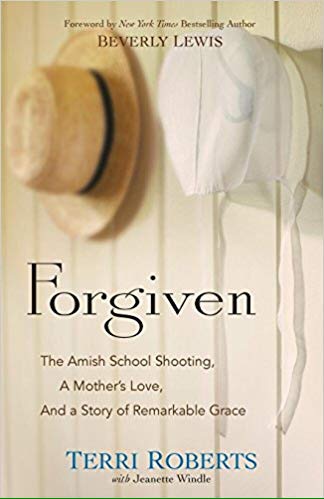
I had no idea when I registered for this half marathon that I would end up driving through Amish country. Having spent part of the morning in that area roughly 20 minutes away, it made complete sense that a portion of the religious section of the library revolved around the Amish lifestyle and beliefs. Remembering this national headline and reading the subtitle of this book, caught was my attention.

In about the right length of a movie-two hours-I knew the story of this family and this event in much more detail. I had learned. I had cried. I had grown. If that’s not a ringing endorsement for a book, then what is?

Question

I’m keeping track of the books I’ve read this year. Yes, I added this title to the list. But I had to answer a question that might sound silly, but it was a real question in my mind. And it wasn’t the first time I’ve wrestled with it. Could I truthfully say I’d read that book? Yes, I read it for two hours. Yes, I knew the story. Yes, I knew the ending. I even looked up whether the author is still alive due to what she shared about her health condition. I knew a lot about this book and its author. But, I didn’t read every word of the book. I read as much as I could in two hours.

So here’s my question to you. If you’re a reader (definition: you read a couple of books a year), how much of a book must you read in order for it to count? 51%? 75%? 100%?

All my life, I’ve been the 100%er. Not no more.

For fun, let’s see your answer. You can comment on this post. Or return to the social media link you followed and post your answer. No shame. Be honest.

6 Lessons from the Blind Runner’s Guide

My last post shared two runners’s story, observed from a distance. They ran a half marathon together on Wednesday; I doubt it was their first nor their last. The uniqueness of one being blind and the other a guide got me thinking. So that post focused on the blind runner, lessons to learn from running blind. So what lessons could we learn from the running guide?

At some time in life, we are a guide. It may be as a parent, an employer, a teacher, a facilitator, a trainer-so many opportunities for us to tether up and lead someone down a path they have never traveled or simply can’t see to navigate on their own. In those moments, we have much to keep in mind, to consider how best to fulfill our role. From the example of guiding a blind runner, here are some things to consider.

  • Relax

If you want your runner to be comfortable and enjoy their experience, you have to lead that part of their journey also. Bringing skepticism or doubt or tension to the start line will make for a long race. So whatever you’ve got to do to step up to the start line relaxed (train a lot, know the course, anticipate questions and concerns, curb your emotions), do it!

  • Forward movement

Being relaxed will help avoid paralysis at the start line. Committing to forward progress will keep you moving long after the gun has sounded. Somewhere along the 13.1 miles, your runner may question if they can finish. Dealing with the possible-only worrying about the next step-will maintain focus on the present and let the future take care of itself.

  • Loose Grip

The tether between Brandon and Adam was less than an arm’s length, long enough to allow space but short enough to control direction and create rhythm. This subtle avenue toward confidence and freedom may be the most important path to trust. Yes, you are needed. No, you are not completely in charge. You are a guide, not a dictator.

  • Follow their Lead

The best leaders know how to follow. On race day, you have to pay attention to how they are feeling, thinking, and responding in that moment. How they were in training or at dinner the night before is irrelevant. How they show up to the start line is what you have to follow. Pay attention and follow their lead. This requires balance; but if you’re relaxed, thinking forward, and holding a loose grip, following will be much easier.

  • Respect their Pace

Get this straight: this is not your race; it’s theirs. If they aren’t thinking anything about setting a personal record or finishing in the top three, neither should you. The pace is up to them. You came to help them accomplish their goals, not yours. Whatever their pace is, respect it.

  • Stay in Your Lane

Drifting in and out of your lane will eventually result in a fall, which could have various consequences. Stay in your running lane. Stay in your emotional lane. Stay in your guiding lane. Commit to knowing your lane and staying in it. Correct any drifting step by step.

Our guiding opportunities can be very rewarding and fulfilling. Let’s embrace them in order to celebrate our tethered partner’s race.

6 Lessons from the Blind Runner


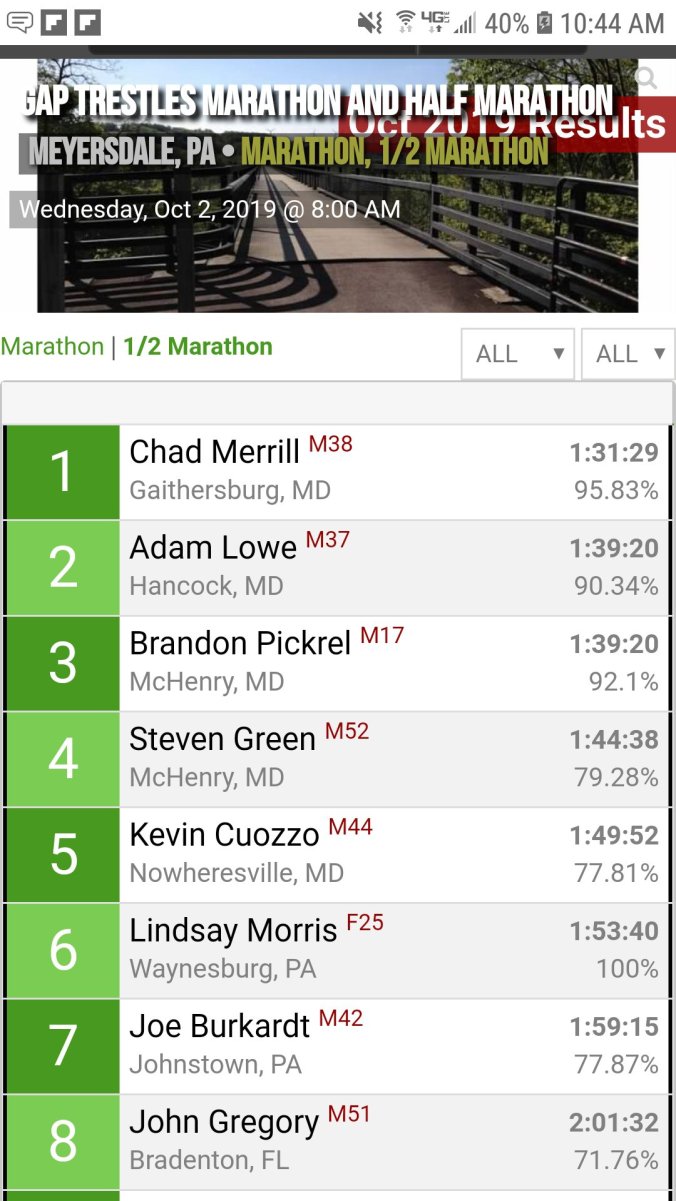
The pic above is a screenshot of the results from the race I ran in PA yesterday. If you know me at all, you know I can analyze the heck out of a list like this. Don’t get me started. Actually, it’s too late anyway…did that hours ago.

Before you focus on my name and placement, let your mind look over the rest of the results. One detail that glares at you is that finishers 2&3 crossed the finish line at the same time. Not unusual in the running world, particularly in smaller, local races. Usually that means family members or running friends ran together, literally-they stayed together, and probably chatted, the entire course length. Not my thing, but it is a lot of people’s.

But without being there yesterday, you wouldn’t know there is more to Adam and Brandon’s story than they ran a race together. And I can’t say I know a whole lot more than that since I didn’t talk to them. But I did watch them. I simply had to. Why? Because one of them wasn’t going to start, let alone finish, without the other one. Brandon was blind, and Adam was his guide.

In a much bigger race I once saw such a team at the start line, but I never saw them on the course after we started. This second opportunity was different. Because of the layout of the course, we passed each other twice. In all, I had four chances to watch them do their thing. And do it they did.

So instead of just analyzing these results yesterday, I thought about what I could learn from these two men. Apparently, quite a bit. Pause and think about them separately. What would it take for you, 17 years old and blind, to attempt to run a half marathon? And if you can see, what would it take for you to guide a blind runner any distance, let alone 13.1 miles? Again, I didn’t talk to them, so I’m guessing what the answers are to these questions.

For the rest of this post, here are the lessons I take away from putting myself in Brandon’s shoes-which seems incredibly assuming.

  • Trust

This has to be the most important thing they both have in their work together. Adam doesn’t have a chance if Brandon doesn’t put his trust in him.

  • Courage

Maybe Brandon’s not seen his entire life and only knows what he knows, but how else can you define his willingness to step up to the start line without declaring courage. I met another runner running his first half yesterday, and he needed some courage. But he could see and was old enough to be Brandon’s dad. Courage was on full display.

  • Joy

Brandon’s face before, during, and after the race exuded joy. Fear, not present. Doubt, defeated. He even ran a recovery mile or so afterwards with that same joyful countenance.

  • Fulfillment

Brandon knew he belonged with everyone else. He experienced the same fulfillment as all finishers do when they cross that line. He did not have to feel or think less than.

  • Exemplify

If I were to ask Brandon what he hopes others learn from seeing him run, I’d put money on his answer being something like, “I hope they see what’s possible. I hope they learn to trust, have courage, pursue joy, and know fulfillment.” (Ok…those are my words, but you get the point.)

  • Normalcy

We are all normal as God created us. Embrace it. Be the normal God made you to be.

To be honest, in life we’re all blind runners. Wouldn’t you agree? So let’s thank God for all the Brandons who show up in our lives to remind us.
What Are You Waiting For?

Two posts ago, I shared a prayer exercise. Here are a couple of stories from my exercise.

One of my five desires that I listed in my journal was “detection of God’s movement.” Since yesterday, my desire has been granted twice.

  1. Monday morning I woke up and sent this message to a friend: “Not sure why, but you dominated my dreams this morning. I spent much time in prayer for you. God loves you.” Last night they responded, “Thanks, friend!!! Means so much and I was up at 4:30am also after bad dreams. Thank you.”
  2. After my race Monday in WV, I drove to PA to run a race Wednesday morning. On my drive, I decided to search for a massage therapist in hopes to schedule an appointment Tuesday. Just so happens, a chiropractor office was across the street from my hotel. I walked over, and they gave me a referral to a local therapist. Long story short, she only had one hour available today. Not only did she give my muscles what they needed, we also talked the entire hour about church, prayer, God, coaching, and life direction. We both agreed…that hour was an answer to our prayers.

If you haven’t tried the exercise yet, what are you waiting for?

Prison Time

“and had him thrown into prison, where the king’s prisoners were confined. So Joseph was there in prison. But the Lord was with Joseph and extended kindness to him. He granted him favor with the prison warden. The warden put all the prisoners who were in the prison under Joseph’s authority, and he was responsible for everything that was done there.”‭‭Genesis‬ ‭39:20-22‬ ‭CSB‬‬

Well, that sounds fun. I’m sure this was exactly what Josph prayed for, and he went in rejoicing that his prayers once again had been heard. SMH

To this point in his life, it’s hard to imagine that Joseph could have had a clue what his life’s purpose was. Regardless what his spiritual gifts assessment revealed or what an elder suggested was his calling, how in the world do you explain his life experiences to date. Yet constantly scripture reads, “The Lord was with him.”

These verses were in my @youversion devotion today addressing the topic of drudgery. Here are a few lines from the devotional thoughts:

What we call drudgery God calls humble and helpful service to others. Patient and steady toil, honoring God right where he put you, in some ways is just as worshipful as singing hymns in church. If you can do it without complaining, all the better.

“Right where he put you.” That’s a challenge. We allow ourselves to see only prison bars (been there, done that). We may even go so far as to break out of jail and basically snub God by saying, under our breath of course, “You Screwed Up…AGAIN!” That view is a flashing neon sign we have stopped thinking more about others and God than ourselves. Joseph’s prison season was quite short compared to his future season of purpose. He didn’t know that at the time, though. He had to trust God was with him and had actually put him there.

If your facing “prison time,” consider these questions:

  • What’s this season for?
  • What’s your trust level in God’s presence and purpose? 
  • How can you honor God in the next 24 hours right where he put you?

Praying Your Desires

James points out a couple of issues in prayer in chapter four.

You desire and do not have. You murder and covet and cannot obtain. You fight and wage war. You do not have because you do not ask. (James 4:2, CSB)

Issues: Lack of right motive and lack of asking

What if we addressed both issues simultaneously? Here’s a suggestion how:

  1. Write down your top five desires
  2. Ask God to check your motives behind each desire
  3. Edit the list as needed
  4. Then pray over the list

I did this exercise today. Here’s what I realized:

  • What I listed as my desires were not things I have regularly been praying for
  • The act of writing down my desires while asking the Holy Spirit what he thought about them made checking my motives easier and, as a result of having already invited him into the exercise, made prayer a normal, flowing, and immediate outcome

Give yourself fifteen minutes to try this exercise this weekend and see how yours goes. Let’s go after praying our desires.

Never Let Him Get to Three

Yesterday on a coaching call an observation was made about a parenting technique. Well, it was more than a observation-more like a self-aware acknowledgement of what not to do.

He noted that several years back he caught himself using the “I’m going to count to three” approach to foster obedience. And for his parenting, he decided this wasn’t working. It was sending a message he didn’t want to send.

This observation wasn’t the topic of the conversation, but it generated a question in connection to the conversation that wouldn’t have been made otherwise. Using the imagery of a parent/child relationship, imagine the Holy Spirit is the parent and the believer is the child. The question is, would the Holy Spirit count to three? If so, what does that say about the relationship? If not, what does that teach us about obedience or about quenching the Holy Spirit?

One could say freewill is a form of counting to three. “Go ahead. Make any choice you want. If it’s not the best one, I’ll be right here when you get back.” One could also say that the longsuffering, mercy, and grace of God is his way of counting to three. I’m not going to argue against either of those views…or others that align with God’s character.

My reflection has led me to a more personal response to this unusual question. While I’m grateful God doesn’t bonk me on the head every time I allow the counting to begin-and maybe go on and on and on-my life experiences have taught me to pursue a quicker response to spirit-led directions and promptings that reflect alignment and obedience. I’d rather not hear the tone of the counting voice, especially not from my grieving Father. But when I do, my aim would be to shorten my response time so that he doesn’t get to three…ever.

The “Right” Quest

I just finished reading Boundaries For Your Soul by Kimberly Miller and Alison Cook. Chances are, since you’re human and created with a soul, you will glean help for your life when you read this book.

Questions you could ask yourself that would indicate so:

  • Are there emotional parts of me that I don’t like?
  • Are there emotional responses I have that I don’t understand?
  • Is there something I’m burdened with that needs resolution?
  • Do my prayers about these things seem unheard or useless and have left me wondering if God cares?

We’ve all had these questions. These ladies have some help for us in their work.

An example from the last chapter entitled “Boundaries With Challenging Parts of Others” involves some insight based on brain science. They discuss the difference between the “thinking” brain and the “emotional” brain. In their discussion they show how important it is to know the difference and to achieve the balance possible when both brains work together. The quote I found intriguing was actually from another Christian psychiatrist’s, Curt Thompson, book Anatomy of the Soul.

We are more interested in knowing right from wrong (a dominantly left-brain hemisphere function used to cope with fear and shame) than knowing God, which requires the integration of all parts of the brain. Our quest to be “right” – a cognitive activity – can actually keep us from deep connection and a holistic knowledge of God and others.

Oh, how many Christians need to be done with the “right” quest, including me.

See what I mean now? Get your hands on this book and see what other insights await you.