You Have Options

Three Saturdays ago I was sleeping the day away, pretty sure I had COVID. Test came back the next day affirming my suspicion.

I test my health often by running. Can I? How did it go? Do I need a nap soon after? Yadda yadda.

Thankfully my case was mild. I “ran a test” with a decent 5k the following Wednesday, but not every run since has been an indicator that all is well.

Earlier this week I set a plan to run each day this weekend-a progressive schedule of six miles on Friday, seven on Saturday, and eight on Sunday. Nothing new. This was a routine schedule this past Fall.

Not sure what it is, but Friday runs since the Summer have occasionally been rough. Yesterday was one of them. I cut it short, ending up with 4.15 miles. I haven’t let my mind look at Fridays any differently…well, until yesterday.

So last night and this morning I debated how far I should run this morning. Not running wasn’t an option I considered. I landed on simply running the same route as yesterday and see how the six went. Around mile two my legs felt pretty much like yesterday, not quite as sluggish. I decided it didn’t matter what pace I had to adjust to, how much walk/running I had to do, six miles was happening today.

A little over three miles I stopped for a quick water break in the park. I didn’t stop long. I didn’t want my body to tell my mind what to do. Somewhere in mile four my legs perked up. I told myself, “Go with it.” I adjusted my course and ran past my next turn taking the next road instead.

I ended up taking four more such turns and completed just under seven miles…with more in the tank.

Here’s my takeaway. We all have days when things don’t go according to plan. We all have to deal with letdowns, apparent failures, missed goals. At the end of those days when we assess the next one, we have options. They range from shutting down to overcompensating. Usually, somewhere in the middle is the best option.

How your next day goes is entirely up to you. You have options.

Photo by Oliver Roos on Unsplash

I’m Here To…

Around mile 2 of my run this morning, I passed a runner who was struggling. And I might add, it’s December 31st and 70F at sunrise, so understandable. I feel you.

But what really caught my eye was his shirt. I hadn’t seen one, but maybe you have. Here’s an example:

Gave me a chuckle. And gave me something to think about the rest of my run.

Was that guy actually making a statement about his running? Or was it “just” the first shirt he grabbed?

Was his apparent struggle to be running supported by his shirt? Or was it a declaration a day early of 2022?

Whatever the case, this statement aligns with how we often show up. And it mostly has to do with that second word. That four-letter word says quite a bit. And it often says, much like a familiar bumper sticker, “I’d rather be somewhere else.” So maybe in that runner’s case, “I’d rather be sitting on my lanai, drinking another cup of coffee, watching College Game Day!”

In the spirit of improving how we show up, let me throw out a couple of suggestions.

One, drop the word “just” anytime you’re making a statement about why you’re anywhere. Whatever amount of tongue biting is involved (been there), stay silent until you can state why you’re there without sounding like you don’t want to be.

Second, on a deeper level in the spirit of New Year’s Eve, how about editing this statement to declare how you desire to show up? “I’m here to __________.” How do you fill in the blank this coming Monday at 8AM? What best completes that sentence for your hopes for the first month of 2022? The first quarter? The entire year?

Declare to yourself, to God, and to whoever else that would benefit, “I’m here to __________.”

Here’s to showing up with purpose in 2022!

Tucson Reflection #4

A little travel trivia for you based on an article by Livability (2016):

  • The average American has visited 12 states.
  • The top five visited states are Florida, California, Georgia, New York, and Nevada.
  • California, Florida, and New York residents have visited fewer states than the typical American.
  • 10% of Americans have never been to a state other than the one they live in.
  • Americans take more than four leisure trips per year.

My Thanksgiving trip of 11 days, counting airports, took me to five states. Looking at these trivia points, it would be foolish of me not to see my life as privileged.

At some point on this trip, maybe on a plane or driving around Tucson, a thought occurred to me. The more I travel to new places the smaller I get. I’m pretty sure it was while I was in Tucson. I’m guessing because Tucson was unlike any other city I’ve visited.

Sure, it is American. Sure, it is modern. Sure, it is multicultural. Sure, it is a University town. Sure, it is picturesque. Sure, it is probably just about anything you’d want a city to be where you live or visit.

Something about Tucson, though, expanded my world and reminded me that the world is quite big. Therefore, I am quite small.

Now, someone might read that and the takeaway would be, “That sounds depressing.” Thankfully, with the worldview I have, my response is the opposite. I’m grateful for the reminder.

Too often my world revolves around me. I’m “bigger” than I really am. Is that because I’m American? Single? Male? White? Privileged? Floridian? Alabama fan? Probably. But it’s also because I’m human, in the lineage of Adam. I fall prey to wanting to be like God.

The smaller we children of Adam see ourselves in comparison to God the better our lives are. We allow the fullness of His presence; we give him more space to reveal he’s bigger. Bigger than us. Bigger than our stuff. Bigger than our circumstances. Bigger than our doubts. Bigger than our fears. Bigger.

On behalf of all the children of Adam, thank you, Tucson! You remind us God is Big!

Photo by REVOLT on Unsplash

Tucson Reflection #3

Running in the Holualoa Tucson Half Marathon had more than one first in store for me.

Yes, it was my first, and most likely only, race in Arizona.

One first I didn’t know was going to happen was sitting on a shuttle bus for over an hour to stay warm before waiting another 30 minutes before the start. It would be nice if that didn’t happen again.

The other first that I did know about beforehand was this…the course was mostly downhill. See below:

Sounds easy. Maybe looks easy. Here’s the deal: it messed with my head. I didn’t make an amateur move and start out too fast. It actually felt like I managed my pace pretty well. But it was deceiving. Although it felt okay, turned out my first, and most likely only, largely downhill race may have messed with my head in a totally new way.

You know the boiling frog syndrome metaphor?

Failing to act in a situation increasing in severity until reaching catastrophic proportions.

Well, it didn’t get catastrophic. No paramedics were involved. Nothing like that.

What happened was I thought I was fine and was going to be able to keep the pace I started, but my body didn’t agree with my head. The subtle impact of the course won. It gave me a reminder. Being comfortable, being fine, going downhill has its own challenges. Adjust. Keep learning. The course, the journey always has something to teach you.

On behalf of all us frogs, thank you, Tucson! May we never stop learning!

Tucson Reflection #2

Getting to Tucson was no joke. The trip started by a 5AM EST (3AM in Tucson) alarm in St. Augustine followed by a three-hour stop in Orlando before boarding flight #1 in Tampa. After a four-hour layover in Denver, the final leg of the trip landed me in Tucson; after a short ride to the AirBnB, I got in bed at 12AM. If you’re counting, that’s a 21-hour day. Not necessarily the smartest start to a weekend for running a half marathon.

When you arrive in the middle of the night to a place you’ve never been, you pretty much have no idea, nor do you really care, what that city has to offer. I apologize to you, Tucson, but I had no idea what you had in store for me when I walked out the door to go to lunch a few hours later. You slapped me in the face with this view:

I didn’t mind the surprise. In fact, I couldn’t get enough. For the next 48 hours, I kept shaking my head and saying to myself, and I guess to God, “What? This is spectacular.”

Maybe it’s because I’ve been in Florida most of my life. Maybe it’s because different is intoxicating. Or maybe it’s because most surprises just aren’t this good.

Regardless of the maybes, here’s what I do know. I will never get over that the Creator of things that slap me in the face also humbled himself to see me, to know me, to rescue me, to offer me hope, to say, “Just wait ’til you see what I’m making for you.”

On behalf of all who visit you, Tucson, thank you! You remind us there’s a matchless surprise to come!

I-35 Lesson #4

Have you ever finished something that you started with dread or uncertainty or self-doubt and thought, “Well, that wasn’t so bad”?

Maybe you jumped out of a plane only because your friend coerced you.

Or you survived the dreaded public speaking gig you just knew would end your life.

Or you breathed in relief after that forever-avoided conversation with that family member.

I was surprised at the frequency of the question “would you do it again?” once someone heard of my completing the I-35 Challenge. The answer is, probably not. But that answer has nothing to do with the experience. It has more to do with how completing a once “questionable something” turned “not so bad something” impacts your mindset.

I-35 Lesson #4: Achievement reveals there’s probably something more

Making the photographer’s job easy (early on Saturday, before I’d hit double digit miles). Photo by @sportsphotoscom.

I’ve experienced it, and I’ve observed it. The lack of confidence at the start line of a race is always alive and well. And for the first-time runner or the first-time attempt at a distance, it’s as much about your mind as it is your legs, your shoes, or your sunglasses.

But somewhere along the journey to completion, the thought crosses your mind, “I’m actually going to get this done. I can’t believe this.” And for many of us, maybe even most, another thought crosses your mind at some point when it’s all over, “I wonder if I can do more.”

Yes.

Yes, you can get that degree.

Yes, you can get that promotion.

Yes, you can climb that mountain.

Yes, you can get completely out of debt.

Yes, you can be a great step-mother.

Yes, you can switch careers in your 40’s.

Yes, you can _____________________.

Yes, there’s more.

Would I do it again? Probably not. There’s something more.

I-35 Lesson #3

My best reading happens on planes. This past weekend was no exception. The book I was reading was a find from listening to the Being Known Podcast. They had referenced it too many times for me to ignore, so I got it. I read the majority of it on this trip. The book is Into the Silent Land by Martin Laird.

I’ll post another blog about this book later, but here’s an excerpt that applied to my running experience for this I-35 Challenge. In it, he is describing a patient who was living with a rare, auto-immune disease.

Health-care professionals, family, and friends arrived to help her and left feeling helped by her. They would end up bringing up their own problems, their own life pain. She would say, “Don’t think about the pain. Be still before the pain.” She didn’t mean to give, and they didn’t intend to receive. But the more she was able to surrender to the loving silence at the center of her pain, the more she was a vehicle of this loving silence.

Medical writer Steven Levine observes “true healing happens when we go into our pain so deeply that we see it, not just as our pain, but everyone’s pain. It is immensely moving and supportive to discover that my pain is not private to me.” This is precisely what Elizabeth discovered about pain. If she could be silent within herself, in the midst of her pain and not get caught up in commenting on the pain, she saw her isolation vanish and what she found, even in the midst of this pain, was communion with all people in the silence of God.

I didn’t come close to Elizabeth’s status while putting myself through self-inflicted pain, but I caught a glimpse of what being still before the pain was like. My quads were already in pain before we started the half on Sunday morning. But as I ran, I focused less on my pain by noticing others who seemed to be dealing with their own that was greater. Communion happened.

This one runner in particular that I came upon around mile 7 got my utmost attention. She may have been 5 feet tall. From behind, it appeared she ran as if one leg might have been shorter than the other. For whatever reason, she seemed to run leaning to her right side. And she ran with a limp. Was it painful? I don’t know. It appeared it was a chronic condition that she lived with every day. And yet, here she was running a half marathon. There we were, fellow embracers of pain.

I-35 Lesson #3: Be still before the pain.

There’s more to see past your pain. There’s more to experience through your pain. Communion. Humility. Maybe even peace.

I’d say I’ve been on this lesson journey all summer. The result: Rather than avoid or complain about pain, embrace it. In the embrace, communion with your fellow embracers is found, and together you experience the presence and peace of God.

I-35 Lesson #2

This photo is a description of a marathon training plan devised by the Hanson brothers. I came across it years ago and loved it the first time I followed it. This plan, in many minds, is not conventional. Why? One main reason is that you never run more than 16 miles. Most plans and trainers would include running at least one 20-miler.

This summer, I had to take an even more unconventional approach to preparing for the I-35 challenge. If you count the number of runs in this plan that are at least 10 miles, there are 21 over the 18 weeks of training. Here’s my total of 10+ mile runs in the five months before race weekend: 4. And the longest…11 miles.

I-35 Lesson #2: Convention may not be necessary.

Summer heat kills any conventional sense for my training for a Fall race. In previous years, I’ve curtailed the summer heat by running on gym treadmills. Due to bad habits forming from too much treadmill running, this summer I swore off treadmills forever-dropped the gym membership completely. Big step.

That step led to figuring out how to train in the heat. And unfortunately for me, that meant running more days and less miles. Even less miles than the Hanson brothers designed. So I knew going into a weekend of 39.3 miles, my approach to getting to both finish lines couldn’t be what I’d prefer.

What’s the lesson here? There is a way to get to the finish line. In fact, just like driving from my home to the office, there are dozens of ways. If you are okay with slower, longer, pauses, breaks, you have many choices. In the end of these choices, you get there.

The majority of us are not elite. So does it really matter what we do to get there? Does it not count if we finish 3,009 instead of 309 or 39? Of course not. What counts is that you did what you could to get to the start line…and then you did what had to do to cross the finish line.

Convention is good, but it’s not necessary.

Somewhere in Kansas City. Photo by @sportsphotoscom

I-35 Lesson #1

This past weekend included many firsts. Seven of them were…

  • Flying Southwest out of Sarasota
  • Visiting Kansas City, St. Joseph, and Des Moines
  • Renting a Truck
  • Buying a Garmin watch
  • Touring the Glore Psychiatric Museum
  • Running a full marathon one day and running a half marathon the following day
  • Driving I-35

These firsts were part of attempting the I-35 Challenge: Run in Kansas City on Saturday then run in Des Moines on Sunday. Looking back on this trip, I have takeaways that I wasn’t even looking for, not expecting, didn’t know was coming. I’m calling these the 1-35 Lessons.

I-35 LESSON #1: Inspiration comes in many forms.

If you’ve never ran a race or had the chance to be a spectator, I encourage you to make it a goal. Whether it’s in person or virtually, you’ll see things that make you turn your head, raise your eyebrow, clap your hands, maybe even shed a tear. If you look long enough, pretty good chance you’ll find inspiration. For example…

In Des Moines, there was a team of runners who stood out because they were wearing red. But the real reason they stood out was because they were all pushing a wheelchair carrying a disabled person. That’s no joke. They are called My Team Triumph. Check out their mission from their website.

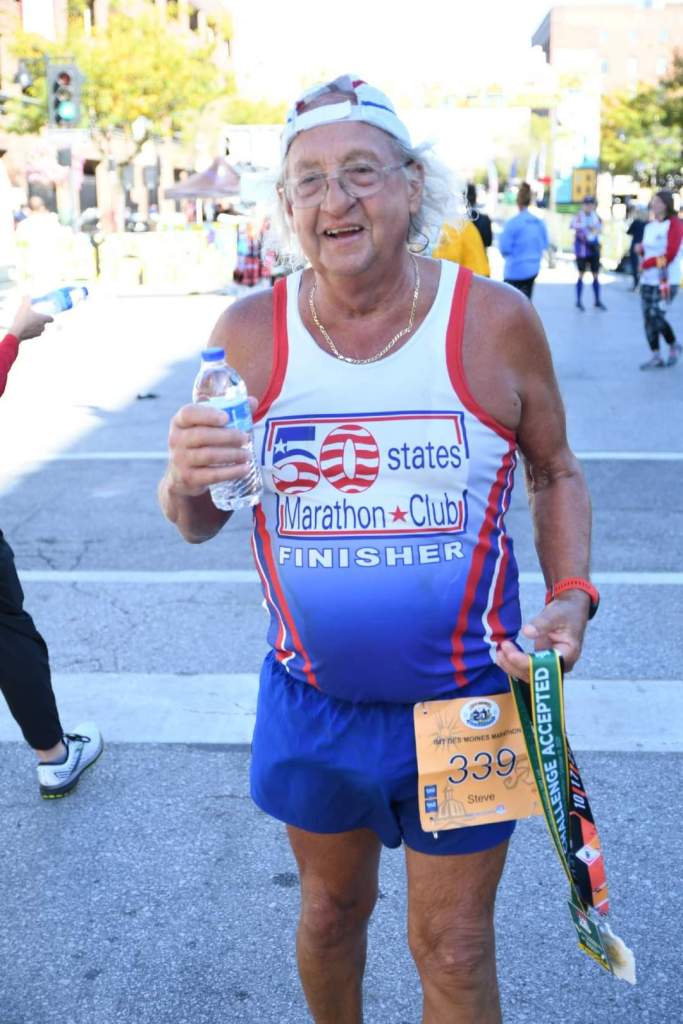
Then there’s this guy. I passed him during the race, but didn’t know his story until hearing him talk about his hobby of running when we happened to be on the same flight the next day. Take a guess how many marathons he’s ran. If you guessed 10…nope. 100…not even close. Try over 700.

These images and others will be in my mind for a long time. These runners showed up. They didn’t settle. And if they had supporters like mine following them virtually and freaking out from home, they didn’t disappoint.

Lesson: Inspiration is around us every day. Take time to reflect, acknowledge, and follow. It may lead you to many firsts of your own.

Crossing the start line in Des Moines…26.2 down, 13.1 to go

Our Batons

This morning I listened to a student pastor speak on the importance of being for the next generation. He used the analogy of passing off a baton in a relay race. His last point was an encouragement to not waste your weakness-meaning your past brokenness, your inabilities, or your inexperience do not disqualify you from being on the track, being part of passing off your baton to the next generation. You can carry a baton and pass it on.

Got me to thinking about the actual baton. What is the baton we are passing off? Is it just a broad view of a way of life? What if each one of us knew in more detail what the baton is that we are carrying? I believe we have our own unique baton that we can pass off to countless others throughout life.

Many things come to mind for me. I have a baton of music that I have passed on in many ways. I have the baton of church leadership that is still running its course. I have a baton of living a contented single life. One could say I have a baton of running that I occasionally pass on.

Those are skills and experiences. We could, and I believe we should, consider our spiritual batons also. These spiritual batons are the core of who we are, how we live. We run with the baton of faith, surrender, peace, hope, love, mercy, humility, kindness, patience-what Paul calls the fruit of the Spirit.

Another thought about our unique baton could include the life challenges that God has used to mature us. These could be anything from experiencing loss of jobs, finances, relationships to seasons of doubt, distance, or disconnect. All of these things make up the baton that we are carrying.

What if we held tight enough to our unique baton making sure we don’t drop it but loose enough to let God keep molding it? What if we passed on these batons as often as we are prompted to while we are living rather than only after we die? What if we lived more for what we relay than what we grip?

You might have to get a wheelbarrow for all those batons. But imagine the impact when your race is over and your batons are still in the race.

Photo by Jonathan Chng on Unsplash