Self-Directed Neuroplasticity

This week I participated in a Q&A following a 40-minute story and message on the subject of overcoming addiction. The story shared was of a woman walking away from her Haitian family’s expectations of her continuing the business of voodoo. The message shared by a pastor focused on how God speaks into our life’s storms; his focus was the Gospel story of Jesus walking on the water and Peter’s attempt to do the same.

In prepping for the Q&A by listening to the pre-recording of the pastor’s message and considering the prepared questions, I revisited a book I read several years ago by Dr. Charles Stone. In his book Brain-Savvy Leaders, Dr. Stone wrote this about change:

When we learn, repeated thoughts about the same subject become mental maps that eventually become habits or deeply engrained beliefs. That’s why reading, studying, and meditating upon scripture is so vital for a Christian. The more we focus on God’s word, the more brain connections we make about this truth, thus reinforcing our values and beliefs. It’s as if the Holy Spirit “rezones” our brains with God’s truth. This change is called self-directed neuroplasticity. The Apostle Paul speaks to this change in Romans 12:2: “Don’t be conformed to the patterns of this world, but be transformed by the renewing of your minds so that you can figure out what God’s will is-what is good and pleasing and mature.”

Chapter 4, Meet Your Brain’s Parts

What in the world is neuroplasticity? Dr. Stone describes it as the reconfiguring and rewiring of neurons that happens when we learn or when the brain “assumes functions it normally doesn’t do by taking over the functions from a damaged part of the brain.”

These thoughts were helpful to bring to the conversation when this question was asked: “What posture helps us stand against our feelings, to keep us from sinking in the storm?” Whatever our feelings are telling us about the storm we are facing, some rewiring can bring hope. However far we have sank, some reconfiguring how to think and live can lift us up.

Our brain’s zoning can be impacted greatly by traumatic events and addictive behaviors. The reality that our brain can be rezoned brings light and peace into one’s stormy life. As for postures-you might say self-directed neuroplasticity-to keep us from sinking, consider these:

  • How can you maintain a posture for learning?
  • How can you establish a posture of meditating on scripture?
  • How can you resist the posture of having your back turned away rather than your face turned toward God?

Photo by Timothy Dykes on Unsplash

Understanding Yes

Yesterday gave me the answer to a question. The question had to do with having said yes and wondering how that particular yes was going to work out. Turns out, pretty good…way better than expected.

The older I get the more weight each yes carries. What I’ve noticed this year focusing on flow, saying yes doesn’t always mean everything’s in order. In fact, the best yes results so far have started with very little in order.

Improving on flow and yes seems to only come by experience. It’s a product of better listening, deeper trust, and reduced paralysis from fear. These improvements, our growth, comes from both our wins and our losses.

For example, David started out with some significant yes wins. He didn’t always have everything in order the moment he said yes, like when he said, “I can take down Goliath.” Five stones later, the flow and the yes made sense. Years later, that win was countered by another yes (Bathsheba) that resulted in lifelong losses. The level at which he flowed with God determined the win or loss of his yes.

Abraham is another example. When God first asked him for a yes, Abraham had no idea how it would work out. But he followed and reaped the benefits of not expecting to understand everything ahead of time. The bumps in the road between then and saying yes to sacrificing Isaac certainly had some losses, but Abraham learned from them and improved his flow and yes to an ultimate level of sacrifice (Genesis 22).

Determining the unity of a yes with Holy Spirit flow can be tricky. One key is discerning where the wish to answer yes is coming from-my own desires or his. And often that discernment can look like asking these three questions:

  1. What is God telling me?
  2. What is God not telling me?
  3. What do I want God to tell me?

None of these questions are bad questions. But I’ve found that the only one that really matters is what is God telling me. Without the answer to that question, a yes or no shouldn’t even be given. I’m also finding that my best understanding of yes is pretty simple. If God is asking for a yes, it’s the best answer. His higher ways and thoughts support my yes. My understanding, secondary to his glory, will come when he’s done with my yes.

Photo by Jen Theodore on Unsplash

Be Light

As the Community Care Director for a counseling center, it’s not uncommon to be in conversations about suicide. Yet, no matter how common it may be, it has yet to feel normal.

And the reason why is because it’s not. It’s a sign of hurt and pain. We live in a broken world, which can result in people’s minds taking them down this dark road. And it’s no respecter of minds.

  • The middle-age pastor’s mind that goes home after leading a Sunday service and questions why he should go on.
  • The twelve-year-old middle schooler’s mind that leads her to a parking lot where she chooses to end her pain.
  • The senior citizen’s mind that says, “I’m done fighting this battle with my body.”

As I witnessed again this morning, when a hurting mind is met with love, empathy, and strength, healing is available. It’s not instantaneous; it’s one step at a time. A step, however small it may be, toward the light may be all that mind needs to stop spiraling into darkness.

Be light to those you know or suspect are lonely, hurting, or in pain. That is normal. And it needs to be more common.

Photo by Melissa Askew on Unsplash

Bunker Life Lessons

This transpired yesterday during Kramer Hickock‘s 3rd round of the PGA Championship in Tulsa.

So many life lessons can be drawn from Hickock’s situation, response, and result.

Rather than me sharing a list for you, I encourage you to watch it several times and make your own list.

After you watch it once, start your list.

Each time you watch it, add more life lessons to your list until you get at least three.

Then share these lessons with someone soon.

We can learn so much from life’s bunker moments. Keys to making these lessons stick with us include pausing to mark them, making note of them, and sharing them. They have more of a chance to become part of us when we do more than just notice them.

Happy Pausing, Noting, and Sharing!

Photo by Peter Drew on Unsplash

Balancing Precision and Fluidity

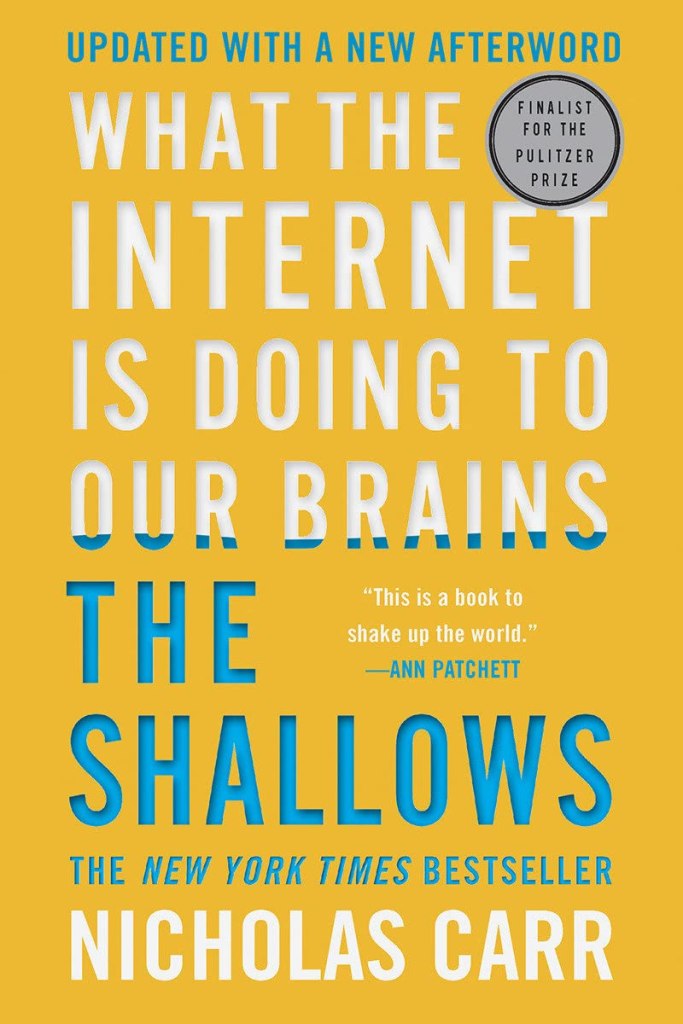
You never know what you’re going to learn by reading a book. Such was the case while reading chapter three in The Shallows by Nicholas Carr.

Chapter Three, “Tools of the Mind,” shares the history and impact of maps, clocks, and language on intellectual development. Carr includes these three in the same technology category, the intellectual technologies. He wrote that maps expanded man’s spatial technology. What maps did for space, clocks did for time.

To describe life before the creation of clocks, Carr quotes French medievalist Jacques Le Goff who said life was “dominated by agrarian rhythms, free of haste, careless of exactitude, unconcerned by productivity.” Hard to imagine such a life. Thinking about it presents a mixture of envy and gratitude.

Carr then shared this bit of history relaying how and why clocks came to be:

Life began to change in the latter half of the Middle Ages. The first people to demand a more precise measurement of time were Christian monks, whose lives revolved around a rigorous schedule of prayer. In the sixth century, Saint Benedict had ordered his followers to hold seven prayer services at specified times during the day. Six hundred years later, the Cistercians gave new emphasis to punctuality, dividing the day into a regimented sequence of activities and viewing any tardiness or other waste of time to be an affront to God. Spurred by the need for temporal exactitude, monks took the lead in pushing forward the technologies of timekeeping. It was in the monastery that the first mechanical clocks were assembled, their movements governed by the swinging of weights, and it was the bells in the church tower that first sounded the hours by which people would come to parcel out their lives.

Like Carr, I don’t share this to make a slam, but to make an observation. Balance is a tricky thing. Some would even say it’s an impossible thing. But like holiness, it’s worth pursuing.

When it comes to time, we can get imbalanced by rigidity and carelessness. We can get lost in the black and white as well as the disregard for parceling and regimentation.

As those seeking to walk in the Spirit, may we follow his lead in the moments when precision is best and when fluidity is lifegiving.

Photo by Aron Visuals on Unsplash

6 Signs of a Great Dad

Yesterday, I heard a dad make two comments in response to things said to him about his children.

The first was about his preschool-age son. Apparently he wasn’t feeling well. When asked about what may have caused the sickness, the dad basically said, “You never know with him.” He didn’t say this with disgust; more like, “He’s his own man.”

The second was about his elementary-age daughter. In talking about how they chose to sit where they were seated, she was given credit for the choice. Dad’s response: “She’s a natural leader.” He didn’t say this with pride; more like, “I can only imagine what’s in store for her.”

I don’t know this dad that well. We’re at the acquaintance stage. But these two comments tell me some things about him.

  • He loves his kids.
  • He respects his kid’s personhood.
  • He’s parenting with the future in mind.
  • He’s not a control freak.
  • He’s pursuing contentment.
  • He’s got a pretty good grasp on his identity.

Photo by Juliane Liebermann on Unsplash

Discovery Run

I did myself a favor. I stuck around another night in Jacksonville after the wedding last Saturday.

What do I have to show for it? For starters, Peterbrooke (well, I did…it didn’t last long), a good movie, and a great dinner.

But the best was my Sunday morning run. I got in 3.8 Saturday morning before meeting friends for breakfast before the wedding. But Sunday morning was what weekend running is all about. No time limits. No expectations. Just exploration. A chance to discover.

The little running I did when I lived in Jacksonville (’90-’02) was all neighborhood (Arlington, Mandarin). I never ran downtown. So I was excited to run around the AirBnB in Springfield and, since it was only a few miles south, Downtown.

There’s a vibe when you run downtown in any city. It’s not the isolation of the country or the ease of a neighborhood. There’s an energy. Even in the absence of traffic, there’s a sense of life unlike anywhere else. And I like it. Especially in the early morning hours.

From running the Main Street bridge, to hearing church bells ring, to discovering Henry J. Klutho Park, it was one of the most pleasant runs in recent memory.

Thank you, Jacksonville! You put a smile on my face every time.

Love Is All Around

I have nine nieces and nephews through the marriages of my three sisters. As of last Saturday, five of them are married. Niece Emily married Connor-the first opportunity I’ve had to be present as an uncle.

The word blossom was used often by the minister and others who voiced words of blessing and prayers over Emily and Connor. Surveying our family, those there and those elsewhere, I like to think the blossoming of love in our family has already happened. What continues to happen is the pollination of love.

Their parent’s love blossomed over 25 years ago. The result of that love is more than a fuller flower. It is a field of flowers. It is love multiplying. Some of those flowers may be still little buds waiting to blossom into marriage. Yet they get to experience the love from all the other flowers in the family field.

The view from this bachelor’s flower in the field is unlike the rest of the family’s. Like any other unmarried person, I’m tempted to believe the whispered lie that I haven’t found love yet. To that I say, lift up your eyes. There’s love all around. The widowed great grandmother and the yet-to-be-married have love.

In their maids of honor speech, Emily’s two sisters joked the three have become two. They also said they welcomed Connor as a brother. They haven’t lost love; they’ve gained love. They aren’t without love; they have received more love.

You Are The House of the Lord

It’s Saturday, which means I’ve listened to another episode of Being Known, specifically episode “Dwell” from season three.

In it Dr. Thompson made a reference that those who place faith in Jesus become indwelt by the Holy Spirit, making them a house of the Lord.

My lyrical brain immediately thought of Phil Wickham’s song by that title. I paused the podcast and listened to that song through the lens that any reference to the house of the Lord was to a believer, not to a building. That was impactful.

In that listening I also considered that perspective suggested a more personal choice of pronouns in the song. So I began changing all the “we’s” to “I.” Even more impactful.

You may not know this song. Here’s the official lyric video. Take a few minutes to listen to the song several times.

First, to familiarize yourself with it.

Then listen from the perspective that you are the house.

Then a final time changing the plural pronouns to singular.

Have a Joy-filled Day!

Stuck on Saturday

During the Easter season the last few years, I’ve been drawn to conversations around not rushing to Sunday. We’d rather not sit in the pain or silence choosing to skip ahead to resurrection. Lucky for us in this century, that’s an option.

Sorry for those that lived Easter weekend in real time. Not an option for them. And although it feels like an option for us each Easter weekend, the reality is that much of our life experience feels a lot like waiting for resurrection. Like it’s a really looooooong Saturday.

  • An unraveling marriage
  • A family feud
  • A wayward child
  • A terminal diagnosis
  • An unfulfilled promise

In many biblical accounts we find company with others stuck on Saturday:

  • Abraham’s years of waiting for the promised son
  • Jacob and Esau’s rivalry encouraged by their parents that caused years of generational pain
  • Joseph’s journey through multiple betrayals, even prison time
  • Esther’s quest to save her people
  • Job’s turmoil of loss, grief, and disease
  • David’s numerous interpersonal relationship challenges that seemed unending

Their stories may be so familiar that we forget or fail to see how much we have in common. Their resurrection took much longer than a weekend…weeks, but mostly years. They had to find a way to live stuck on Saturday. Truth is, until eternity is our norm-the ultimate resurrection, we’re all stuck on Saturday. The how-to-live-on-Saturday list is long, but here are my top three, Easter 2022:

Stop trying to make it happen…that’s what Abraham did. What a mess! It’s better to wait for the promise keeper to move the stone than to derail your life attempting to do his job for him.

Remember whose you are…that’s what David did. What a heart! It’s healthy to blurt, wail, lament, and even curse in order to create the space for praise from a sheltered, created, purposed, and everlastingly loved child.

Keep the communication lines open…that’s what they all did. What examples! It’s freeing to lean not on your own understanding by trusting that what is coming on Sunday is something only possible from higher ways and thoughts.

Stuck on Saturday? It’s not fun. Yet the forced gaze on the stone mover is worth it.

Photo by Sincerely Media on Unsplash