I-35 Lesson #4

Have you ever finished something that you started with dread or uncertainty or self-doubt and thought, “Well, that wasn’t so bad”?

Maybe you jumped out of a plane only because your friend coerced you.

Or you survived the dreaded public speaking gig you just knew would end your life.

Or you breathed in relief after that forever-avoided conversation with that family member.

I was surprised at the frequency of the question “would you do it again?” once someone heard of my completing the I-35 Challenge. The answer is, probably not. But that answer has nothing to do with the experience. It has more to do with how completing a once “questionable something” turned “not so bad something” impacts your mindset.

I-35 Lesson #4: Achievement reveals there’s probably something more

Making the photographer’s job easy (early on Saturday, before I’d hit double digit miles). Photo by @sportsphotoscom.

I’ve experienced it, and I’ve observed it. The lack of confidence at the start line of a race is always alive and well. And for the first-time runner or the first-time attempt at a distance, it’s as much about your mind as it is your legs, your shoes, or your sunglasses.

But somewhere along the journey to completion, the thought crosses your mind, “I’m actually going to get this done. I can’t believe this.” And for many of us, maybe even most, another thought crosses your mind at some point when it’s all over, “I wonder if I can do more.”

Yes.

Yes, you can get that degree.

Yes, you can get that promotion.

Yes, you can climb that mountain.

Yes, you can get completely out of debt.

Yes, you can be a great step-mother.

Yes, you can switch careers in your 40’s.

Yes, you can _____________________.

Yes, there’s more.

Would I do it again? Probably not. There’s something more.

I-35 Lesson #3

My best reading happens on planes. This past weekend was no exception. The book I was reading was a find from listening to the Being Known Podcast. They had referenced it too many times for me to ignore, so I got it. I read the majority of it on this trip. The book is Into the Silent Land by Martin Laird.

I’ll post another blog about this book later, but here’s an excerpt that applied to my running experience for this I-35 Challenge. In it, he is describing a patient who was living with a rare, auto-immune disease.

Health-care professionals, family, and friends arrived to help her and left feeling helped by her. They would end up bringing up their own problems, their own life pain. She would say, “Don’t think about the pain. Be still before the pain.” She didn’t mean to give, and they didn’t intend to receive. But the more she was able to surrender to the loving silence at the center of her pain, the more she was a vehicle of this loving silence.

Medical writer Steven Levine observes “true healing happens when we go into our pain so deeply that we see it, not just as our pain, but everyone’s pain. It is immensely moving and supportive to discover that my pain is not private to me.” This is precisely what Elizabeth discovered about pain. If she could be silent within herself, in the midst of her pain and not get caught up in commenting on the pain, she saw her isolation vanish and what she found, even in the midst of this pain, was communion with all people in the silence of God.

I didn’t come close to Elizabeth’s status while putting myself through self-inflicted pain, but I caught a glimpse of what being still before the pain was like. My quads were already in pain before we started the half on Sunday morning. But as I ran, I focused less on my pain by noticing others who seemed to be dealing with their own that was greater. Communion happened.

This one runner in particular that I came upon around mile 7 got my utmost attention. She may have been 5 feet tall. From behind, it appeared she ran as if one leg might have been shorter than the other. For whatever reason, she seemed to run leaning to her right side. And she ran with a limp. Was it painful? I don’t know. It appeared it was a chronic condition that she lived with every day. And yet, here she was running a half marathon. There we were, fellow embracers of pain.

I-35 Lesson #3: Be still before the pain.

There’s more to see past your pain. There’s more to experience through your pain. Communion. Humility. Maybe even peace.

I’d say I’ve been on this lesson journey all summer. The result: Rather than avoid or complain about pain, embrace it. In the embrace, communion with your fellow embracers is found, and together you experience the presence and peace of God.

I-35 Lesson #2

This photo is a description of a marathon training plan devised by the Hanson brothers. I came across it years ago and loved it the first time I followed it. This plan, in many minds, is not conventional. Why? One main reason is that you never run more than 16 miles. Most plans and trainers would include running at least one 20-miler.

This summer, I had to take an even more unconventional approach to preparing for the I-35 challenge. If you count the number of runs in this plan that are at least 10 miles, there are 21 over the 18 weeks of training. Here’s my total of 10+ mile runs in the five months before race weekend: 4. And the longest…11 miles.

I-35 Lesson #2: Convention may not be necessary.

Summer heat kills any conventional sense for my training for a Fall race. In previous years, I’ve curtailed the summer heat by running on gym treadmills. Due to bad habits forming from too much treadmill running, this summer I swore off treadmills forever-dropped the gym membership completely. Big step.

That step led to figuring out how to train in the heat. And unfortunately for me, that meant running more days and less miles. Even less miles than the Hanson brothers designed. So I knew going into a weekend of 39.3 miles, my approach to getting to both finish lines couldn’t be what I’d prefer.

What’s the lesson here? There is a way to get to the finish line. In fact, just like driving from my home to the office, there are dozens of ways. If you are okay with slower, longer, pauses, breaks, you have many choices. In the end of these choices, you get there.

The majority of us are not elite. So does it really matter what we do to get there? Does it not count if we finish 3,009 instead of 309 or 39? Of course not. What counts is that you did what you could to get to the start line…and then you did what had to do to cross the finish line.

Convention is good, but it’s not necessary.

Somewhere in Kansas City. Photo by @sportsphotoscom

I-35 Lesson #1

This past weekend included many firsts. Seven of them were…

  • Flying Southwest out of Sarasota
  • Visiting Kansas City, St. Joseph, and Des Moines
  • Renting a Truck
  • Buying a Garmin watch
  • Touring the Glore Psychiatric Museum
  • Running a full marathon one day and running a half marathon the following day
  • Driving I-35

These firsts were part of attempting the I-35 Challenge: Run in Kansas City on Saturday then run in Des Moines on Sunday. Looking back on this trip, I have takeaways that I wasn’t even looking for, not expecting, didn’t know was coming. I’m calling these the 1-35 Lessons.

I-35 LESSON #1: Inspiration comes in many forms.

If you’ve never ran a race or had the chance to be a spectator, I encourage you to make it a goal. Whether it’s in person or virtually, you’ll see things that make you turn your head, raise your eyebrow, clap your hands, maybe even shed a tear. If you look long enough, pretty good chance you’ll find inspiration. For example…

In Des Moines, there was a team of runners who stood out because they were wearing red. But the real reason they stood out was because they were all pushing a wheelchair carrying a disabled person. That’s no joke. They are called My Team Triumph. Check out their mission from their website.

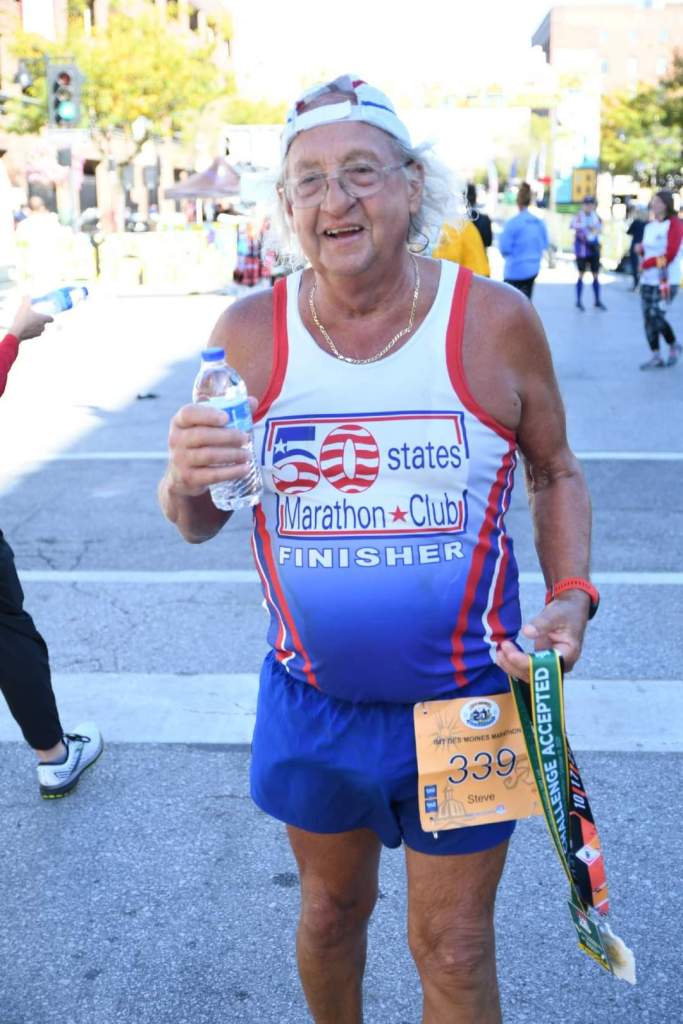
Then there’s this guy. I passed him during the race, but didn’t know his story until hearing him talk about his hobby of running when we happened to be on the same flight the next day. Take a guess how many marathons he’s ran. If you guessed 10…nope. 100…not even close. Try over 700.

These images and others will be in my mind for a long time. These runners showed up. They didn’t settle. And if they had supporters like mine following them virtually and freaking out from home, they didn’t disappoint.

Lesson: Inspiration is around us every day. Take time to reflect, acknowledge, and follow. It may lead you to many firsts of your own.

Crossing the start line in Des Moines…26.2 down, 13.1 to go

Birthday Weekend Race

When possible, it’s fun to run a race around my birthday. Last year for #50, friends joined me to run a 50k in Mississippi. That trip prompted me to decide to run a full marathon this year-my first since 2012. So for full #5, I found a race in Westerly, Rhode Island. Checked off state #18.


What a nice choice! This is a great shoreline city in the Ocean State.


And I booked a terrific Airbnb only 10 minutes from the race startline. Thanks, Bob and Gina!

Not everyone would choose to run a race on a 3-day birthday weekend. But whatever helps you celebrate well, don’t forget to do it.

Good Crying

Crying. When you think of that action, most likely you think of something bad or sad happening. It ain’t good if you’re crying.

During a segment on 60 Minutes tonight, a NASA engineer described going home the night after a stressful but successful project of landing Curiosity, a car-sized robotic rover exploring Gale Crater on Mars. He said, “I crawled into bed with my wife and wept.” He didn’t sound sad at all. He sounded joyfully spent, exhaustedly happy. 

Have you ever experienced that kind of crying? You might call it having a good cry. I’ve had some. One that particularly comes to mind was at the end of my last marathon in 2012. I tried to control it, but there was no controlling it. I was joyfully spent, exhaustedly happy.

What are you working on that you are so committed to that when it’s over you could have a good cry? What life mission are you following that makes you have a good cry occasionally? When was your last good cry?

Go after being joyfully spent. Go after good crying.