Hope in the Waiting of Lent (book review)

A few weeks ago I decided to find a book about Lent. I’ve read articles about Lent, but I don’t recall reading a book about it. My search led me exactly to what I was looking for.

I found that Esau McCaulley and I share two things: we grew up in Alabama, and our church upbringing didn’t include Lent. Kindred spirits. I’ll have to research to see if he roots for the right football team.

I knew I was reading the right selection when he ended his introduction with these two sentences:

What follows is an attempt to point out the things I’ve seen along the way. It is not just an explanation of Lent but an invitation to experience it, a chance to meet our risen Lord who always runs just ahead of us, beckoning us forward.

Only four chapters long, the book is manageable, ideal before and throughout Lent’s forty days. For those looking for the how’s of Lent, chapter two covers seven rituals of Lent. For those questioning the place and value of rituals, chapter three walks through the prayers and scriptures of Lent.

Ritual is both a means of spiritual formation (we learn through repetition) and an encounter (God meets us in the act of worship and praise in the liturgy)…we do not outgrow God. We never arrive at a place where we are able to “take it from here.”

The final chapter is a beautiful walk through Holy Week. Whether you grew up fully aware of Holy Week or it’s a new journey for you, McCaulley encourages embracing the freedom found in the repentance and renewal of each day and its reflection.

As it is the end of Holy Saturday, here’s one reflection about this day:

At this point in the Gospel story, there is no work left for the disciples to do. There are no more great deeds to perform. All that remains is the waiting. Holy Saturday reminds us-as the Sabbath itself does-that for all our activity, our hope is not in the things we accomplish.

I wish you hope in the waiting.

Sabbath Beauty

My Friday night journal entry included a weekend/Sabbath commitment/exercise. Look and make note of beauty for 48 hours.

Of all the observations, these were the four most notable, counting down to #1.

#4

Papa Cleve’s Jamaican ice cream in Miami is legit. The two flavors I chose were Oreo Cheesecake and Coffee. Check out this video: https://www.facebook.com/share/v/15j1T2e8GL/

#3

Came across this song by Benjamin William Hastings. Added to my 2025 Rest playlist. I couldn’t find a “story behind the lyrics.” I have strong suspicions, but I’ll let you listen for the message you get.

#2

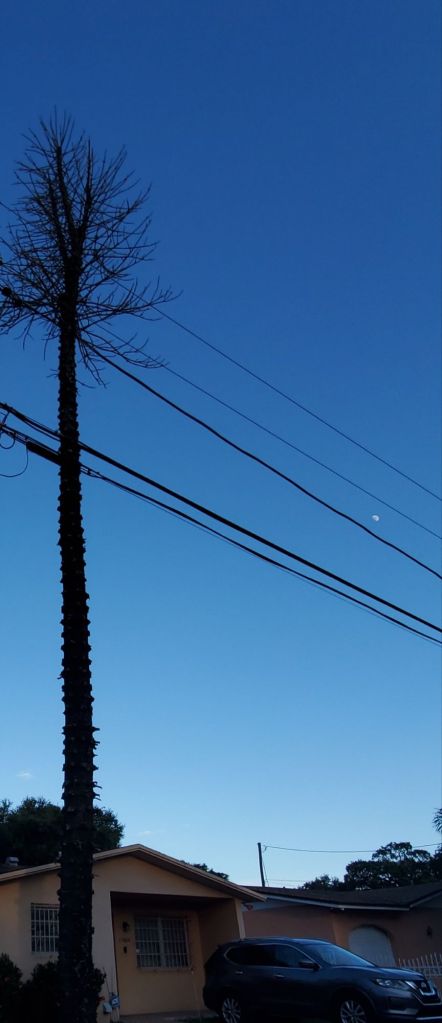
Trees are one of my favorite creations. This one a few blocks from my Airbnb in Miami captured me. I had to drive back by to get a quick photo. It doesn’t do it justice. It looks burnt. I’d like to know it’s story. Whatever it is, the message to me is, “I’m still here.”

#1

No picture or video. Why? It’s what happens when you run without a device.

Yesterday morning the first image of beauty to start my exercise was of a hoverboard rider. We passed one another on opposite sides of Old Bradenton Road around 6:05AM. I don’t even know if he saw me. I heard him before I saw him. I thought he was listening to music. Turns out, he was singing along to it, louder than I could hear it. It was hard to tell what he was saying, but I caught enough to suspect it was a praise song. That’s right. A hoverboarder starting his Saturday on a ride worshipping. How can that not be #1?

Today, I Remember

May 31st was Memorial Day. A holiday to remember those who have given their life for freedom.

That morning I decided not to start my day with a run. Instead I felt led to have a Sabbath moment. Just follow the promptings and see where they led.

To begin, I picked up my Bible reading where I was. It just happened that I was reading in Exodus where the Israelites were first instructed about Passover. I’ve read that many times. But on this particular day, it mattered a little more when I read this verse:

“This day is to be a memorial for you, and you must celebrate it as a festival to the Lord. You are to celebrate it throughout your generations as a permanent statute.” Exodus 12:14

How could I ignore the connection, right? So, note to self.

I don’t remember how or why, but after I finished reading I came across a youtube video of Max Lucado sharing a personal story that I hadn’t heard before. The title read “Max Lucado Testimony: Jesus Healed Me From Sexual Abuse.” About three minutes into this clip, Max shared a unique communion experience he took upon himself to take when he was twelve years old. He described going to the refrigerator and finding what he could to observe communion right then and there. He felt like he needed to remember. He ended up with a glass of milk and leftover potatoes. And in his heart, he remembered and felt cleansed and embraced as he took that private moment to remember.

How could I ignore the connection, right?

Now it was more than a note to self. It was a call to remember right then. So I followed Max’s example and went to the refrigerator. I ended up with a bagel and a cup of fruit punch. Then with further scripture reading and listening to a playlist I put together of communion music, I had an hour or two of memorial and celebration.

It hit me that a further following of Exodus 12:14 could be that I make this a habit. I don’t have to wait on my church to dictate when I remember and celebrate. I can follow God’s direction and repeat this moment whenever I wish.

For now, I’m putting it on my calendar once a month. And this morning was that time. And I share this for you to consider how you might make remembering and celebrating a part of your home as well.

(From my time this morning) Today I remember that…

  • you were betrayed
  • you knew what you were doing
  • you desired to be glorified
  • through you your Father was glorified
  • envy was your enemy
  • you chose to give your life
  • you are the way to life now and forever
  • you knew the prophecies and surrendered to their fulfillment
  • you could have stopped it all
  • you were alone
  • you gave the charge to love one another
  • the shedding of your blood washes away my sin
  • you humbled yourself completely to the point of death

Photo by David Weber on Unsplash

2020: Restorative? 

Recently I received a copy of an essay about grief and COVID-19 entitled “This Too Shall Pass,” coauthored by Alex Evans, Casper ter Kuile, and Ivor Williams. My personal takeaway was I need to grow as a collective mourner.

However, the most intriguing content was the hope of restoration following the pandemic, following the grief. And believe it or not, they referenced two Old Testament concepts-Sabbath and Jubilee years-as their example. Here’s the excerpt:

The idea of self-sacrifice that leads to rebirth found its concrete application in the ancient concept of Jubilee. In the original biblical context, every seventh year was a sabbatical year: a time of “solemn rest for the land.” No crops were sown. Instead, people lived off what the land produced naturally, with the soil given time to lie fallow so as to maintain its fertility. Then, every seventh sabbatical year was a Jubilee, when in addition to normal sabbatical year observances, land ownership would be reset to prevent inequalities building up, debts canceled, prisoners freed, and everyone would return home.

In fact, Sabbath and Jubilee years were the socio-political version of atonement: a set of concrete procedures for how to correct economic, social and environmental imbalances through resting, slowing down, halting economic activity, and sacrificing the grasping ego that always demands more, in order to protect the covenant.

These principles turn out to be profoundly relevant to our own crisis today. Countries all over the world have released prisoners. Low income countries have seen $12 billion of debt payments suspended. Some governments are moving to find homes for all rough sleepers. Proposals for a universal basic income look closer to being implemented than ever before. With the world economy on lockdown, carbon emissions and air travel are in freefall while air quality has improved dramatically; in many cities, people can hear birds singing or see stars at night for the first time.

2,500 years after the rules for Jubilees were codified in the book of Leviticus, they have bubbled up from our ancestral memory once more.

Is there grieving? Yes. Most likely more than we may have taken time to grasp. 

Should we grieve? Yes. It’s natural. It’s healthy. It’s restorative.

Is 2020 restorative? Possibly. Looks like that might be up to us. You in?

Photo Credit: Unsplash/Jack Sharp

The Ruthless Elimination of Hurry (book review)

Love, joy, and peace are at the heart of all Jesus is trying to grow in the soil of your life. And all three are incompatible with hurry.

If that statement intrigues you, welcome to Pastor John Mark Comer’s new book, The Ruthless Elimination of Hurry.img_1006-1

In a world of increasing speed, we all know it’s out of control. What we may not know is how to slow ourselves down in the midst of it. That is what Comer addresses convincingly, humorously, and practically.

Wisdom is born in the quiet, the slow. Wisdom has its own pace…When we uncritically hurry our way through the digital terrain, we make the devil’s job relatively easy.

After defining the problem and offering solutions in parts one and two, Comer offers four practices in part three that will eliminate hurry: silence&solitude, sabbath, simplicity, and slowing.

Mindfulness is simply silence and solitude for a secular society. It’s the same thing, just missing the best part-Jesus.

It is not as though we do not love God – we love God deeply. We just do not know how to sit with God anymore.

Contentment isn’t some Buddhist-like negation of all desire; it’s living in such a way that your unfulfilled desires no longer curb your happiness.

We achieve inner peace when our schedules are aligned with our values.

I’ve recommended several books with a similar theme as Comer’s (The Rest of God, Rhythms of Rest, Awe). Add this to the list. He offers a broader look at the theme with relatable application. I don’t think he’d mind if I suggested you hurry to get this book in your hands.

“We know how powerful those things are”

The smartphone, with its endless apps, is designed to whisper to you that the thing you are doing is not the thing you ought to be doing. The phone isn’t encouraging your progress; it’s causing you stress. Want to know what hostile AI [artificial intelligence] looks like? You’re holding it.


That’s a quote from chapter six, Set Tech Limits, from Ben Sasse’s book Them. There’s a reason that this chapter is the longest in his book. He’s preaching, quite convincingly, that the quick advancement of technology is a major contributor to the cultural challenges in America. These challenges are apparent by the fact that Silicon Valley entrepreneurs creating these advancements don’t want their own kids to have iPads and smartphones. “We know how powerful those things are.”

There’s so much in this chapter that, unless you keep up with all the latest tech news, you have no idea about-the possibility of living to 200 because of advancements like our skin transmitting information to the internet or microscopic computers swimming around in our bloodstream repairing cancers before they are diagnosed, to name a couple. These sound like good things. Sasse shares also some bad things, particularly those that will impact the generations who don’t know a world without AI.

He doesn’t drop the fear and leave. Sasse provides doable suggestions for setting technology limits for yourself and your family. He shares his personal boundaries for how long he engages technology and at what time of day. For his family, they observe a “digital Sabbath” for a big chunk of Sundays. Other practical suggestions include turning off notifications, stop checking likes, read comments only at a predetermined time, and unfollow politics addicts.

This post is my final post referencing Sasse’s book. My recommendation is:

  • If you are American, read it
  • If you are a parent, read it
  • If you are culturally concerned, read it
  • If you are desiring healing encouraged by love in your family and your community, read it

Sabbath Model

The subject of rest and Sabbath has become a constant for me over the last twelve months through leading a coaching program and co-leading webinars. If I’ve learned anything in this time, it’s that we could all use more conversing about this as well as more examples of it.

In that light, I thought I’d share how mine went yesterday with some notes.

It didn’t last all day. First thing, I had to deal with some car stuff. Finished and back home at 11.

The next seven hours were my time to “embrace that which gives life.” (Sabbath’s golden rule according to Mark Buchanan, author of The Rest of God.)

Those seven hours included reading devotions and two other books, blogging, meditating, napping, and going to the gym (in this period of my Sabbaths, the TV is not on). None of this felt like work. (Another aspect to Sabbath’s golden rule.) At the end of those seven hours, I could say I had more “life”; you could even say more peace.

No one model of Sabbath fits everyone. While reading may give one person life, it may drain another person. Similarly, playing golf would drain me (probably more like kill me) but would completely bring joy to some friends of mine. So to give us all some kind of guide, here’s a reminder of the golden rule for Sabbath: cease that which is necessary in order to embrace that which gives life.

What could you embrace during your next Sabbath?

Sabbath Webinar

Over the years, the subject of Sabbath has created some interesting conversations. This year, it’s gotten more intentional as I’ve led two groups through a coaching program about it and watched the participants walk away with a new perspective and personal plan about Sabbath.

For readers in the U.S. and around the world, it would be even more interesting to hear from one another about your Sabbath practices, or lack of it. Earlier today, I teamed up with fellow coach Tonya Waechter to share a webinar, part one of three, regarding Sabbath. You can watch it here: Webinar.

Tonya and I would love to hear your insights and then have you join us for webinar parts 2&3.

Realignment Day

Five weeks ago I self diagnosed a need. I had a need for a day unlike any day I’ve experienced before. This need was driven by various things. Did I need rest? Yes and no. Did I need time with God? More yes than no. What did I most need was my question. I took this to my coach and what I came up with was this: I needed realignment.

I’ve never heard of a realignment day, but it resonated with me. Since it was self diagnosed, that meant I had to come up with the “treatment plan.” I went into the day with some structure, but very loosely held. I knew prayer and reading would play a major role, but how long and with what content I wanted to be fluid and hopefully spirit led. I’ll share some of how the day went and give you something to consider for your own realignment day.

  • To establish why the title of realignment, I considered these definitions: 1. To place back in line, to bring back into line. 2. To rejoin as an ally. In the consideration, I looked at biblical examples of folks who needed and received realignment such as Adam and Eve, Samson, David, Jacob and Esau, Hosea and Gomer, Moses, Jonah, the prodigal son, and Peter.  This led me to a personal conclusion: I need to realign with how God sees people, with his grace, and with who I am in his eyes. This foundation led the rest of the day’s activities. These activities including reading, praying, and worshipping through music.
  • Reading: four scripture passages and portions of two books about these passages. Some of this was planned and some not. I knew that I was drawn to reading prayers and conversation between Moses and God. But in the moment I was led to other passages from Daniel, Job, and I John. These passages illustrated what is needed for realignment and how to pray for it.
  • Praying: confessional and covenantal. The truth about realigning with God is that he isn’t the one that got out of line. So realignment should include confessing where you got out of line and covenanting about staying in line. But before I wrote out those two prayers I started the conversation with God by asking him this: “What messages do you want to share with me?” To my surprise, he had a lot to say-a full page, a total of 13 clear and specific messages. Those alone were worth the effort and intentionality of the day.
  • Music: listening and creating. Again, to my surprise I was led to listen to one particular song throughout the day. Then as a result of reading and praying, a new song was birthed in my spirit. By the end of the day, where I ended up at a bayside park, not only was I realigned but I also had a song of offering to give back to God and to others what my realignment day had given to me.

Not everyone requires the same type of realignment, but I’m convinced we all need it occasionally. 

  • Are you due? 
  • What could assist you in realigning? 
  • How vital should a realignment day be in order for you to make it happen? 
  • What surprises could God have in store for you on your realignment day?